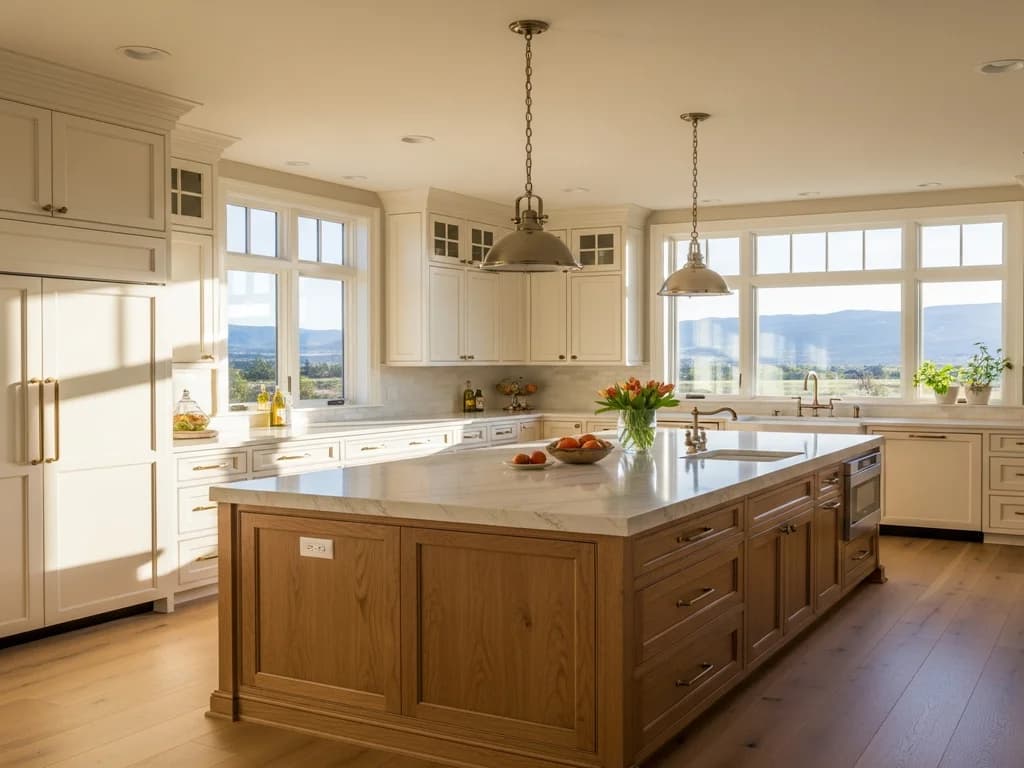
Under-cabinet lighting: the workhorse
Under-cabinet lighting — usually a low-profile LED strip or puck lights mounted beneath the upper cabinets — is the most useful lighting in a kitchen. It puts light directly on the countertop where you prep, eliminating the shadow your own body casts when the only light is overhead. Mounted toward the front underside of the upper and shielded by a light rail, it lights the counter without glaring in your eyes or reflecting off the backsplash.
In-cabinet and glass-front lighting
Lighting inside cabinets — especially glass-front uppers, display shelving, or a wine cabinet — turns storage into a feature. Warm LED strips along the interior sides make glassware and dishware glow and give a kitchen a soft, layered evening look. On a display or bar cabinet, interior lighting is often the detail that makes the whole piece feel custom rather than utilitarian.
Toe-kick and accent lighting
A strip of LED tucked into the toe-kick at the base of the cabinetry casts a soft glow onto the floor — a low, ambient light that’s beautiful at night and doubles as a gentle nightlight for a midnight glass of water. Similar accent lighting above the cabinets, where there’s a gap to the ceiling, washes the ceiling and adds depth. These are finishing touches rather than task lighting, but they’re what make a kitchen feel considered.
Plan the wiring before the build
The key thing to understand is that cabinet lighting is a design decision, not a later add-on. The wiring, switching or dimming, and any transformers have to be planned so the cabinetry can be built to conceal them — routed through the boxes, hidden behind light rails, and controlled cleanly. Deciding you want under-cabinet lighting after the kitchen is installed means visible cords or opening walls. We plan the lighting layout during design so the cabinetry is built to hide it entirely.
- Under-cabinet LED for countertop task light.
- Interior lighting for glass-front and display cabinets.
- Toe-kick glow for soft ambient and nightlight use.
- Wiring, switching, and transformers planned before the build.
Frequently Asked Questions
Do I need to decide on cabinet lighting before the cabinets are built?
Yes. The wiring, switching, and transformers have to be planned so the cabinetry can be built to conceal them. Adding under-cabinet or interior lighting after installation usually means visible cords or opening walls.
What color temperature is best for kitchen cabinet lighting?
Most homeowners prefer a warm-to-neutral white (roughly 2700K–3000K) for a cozy, flattering look, though some like a slightly cooler light for task areas. Dimmable LEDs let you tune the mood.
Building or remodeling in the Treasure Valley?
Alderwood designs, builds, and installs custom cabinetry in-house across Idaho’s Treasure Valley. Tell us about your project and we’ll start with a design conversation.
Request a Consultation