What the big-box path offers
Big-box and home-center cabinets are stock or semi-custom lines: standard box sizes, a set menu of doors and finishes, and often in-stock or short lead times. The appeal is real — lower cost, quick availability, and a familiar buying process. For a simple layout, a rental, or a tight budget, it can be exactly the right call.
The limits are the ones inherent to catalog cabinetry: fixed sizes closed with filler where the room doesn’t cooperate, particleboard or thinner cases in many lines, and a buying process where sales, manufacturing, and installation are three separate parties. If something doesn’t fit on install day, there isn’t one person who owns the whole outcome.
What a cabinet maker offers
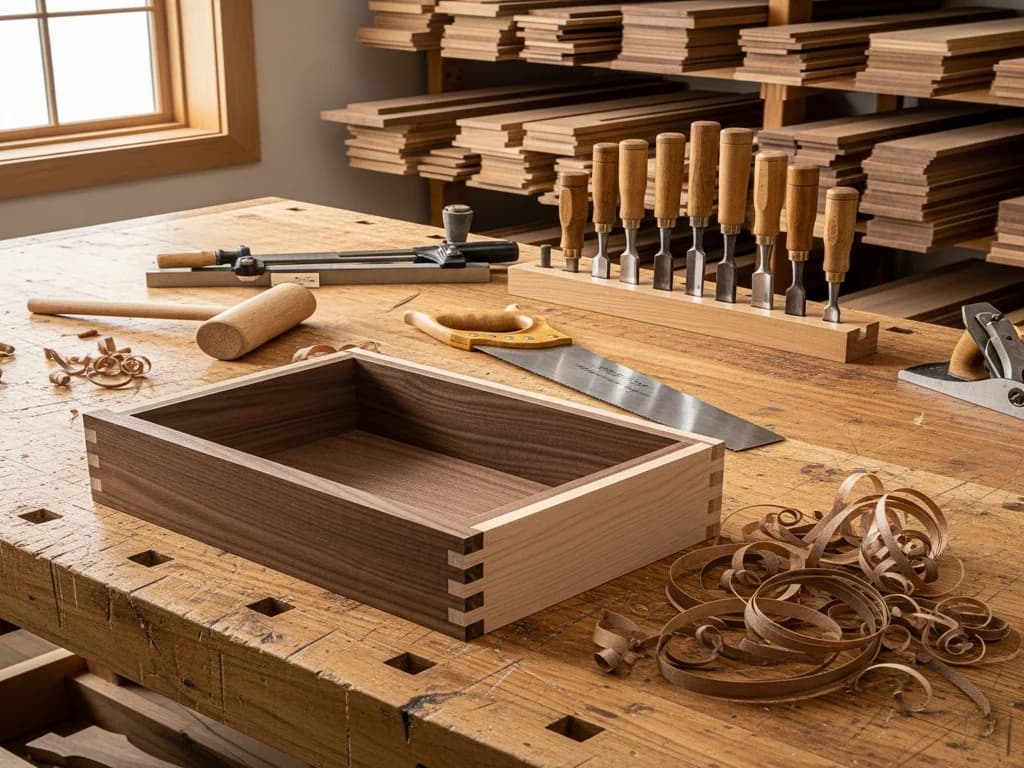
A custom cabinet maker builds to your room instead of to a grid. You choose the wood species, door style, finish, joinery, and interior fittings without a catalog’s limits, and the cabinetry is sized to the wall so the fit is tight and the fillers are minimal. Construction is typically more robust — plywood cases, dovetailed solid-wood drawer boxes, quality soft-close hardware.
At a vertically integrated shop like Alderwood, the same team designs, manufactures, and installs, so accountability lives in one place from the first drawing to the last adjustment. That is the practical thing you’re buying alongside the cabinetry: a single point of responsibility.
Honest trade-offs
Custom generally costs more per linear foot and takes longer, because it’s built to order rather than pulled from a shelf. Those are genuine trade-offs, not fine print. The question is whether your space and goals reward them — a straightforward kitchen may not, while an irregular room, tall ceilings, a specific material, or a desire for cabinetry that lasts decades usually does.
- Choose big-box for simple layouts, tight budgets, or fast timelines.
- Choose a cabinet maker for irregular spaces, specific materials, robust construction, and single-point accountability.
A middle question worth asking
Before defaulting to either, it’s worth pricing your actual kitchen both ways. On a complex room, a semi-custom big-box quote can climb with all its modifications and fillers until custom is closer than expected — and you may find the fit and materials of custom are worth the gap. On a simple room, the big-box path may genuinely be the smart, economical choice. The answer is specific to your space, which is why we’d rather measure it than generalize.
Frequently Asked Questions
Are big-box cabinets bad quality?
Not necessarily — lines vary widely, and better ones are perfectly serviceable. The consistent differences are in fit to your specific room, construction materials, and whether one party is accountable for the whole result.
Is custom always the better choice?
No. For a simple layout or a tight budget, a stock or semi-custom kitchen can be the right, economical decision. Custom earns its cost on irregular spaces, specific materials, and long-term durability.
Building or remodeling in the Treasure Valley?
Alderwood designs, builds, and installs custom cabinetry in-house across Idaho’s Treasure Valley. Tell us about your project and we’ll start with a design conversation.
Request a Consultation