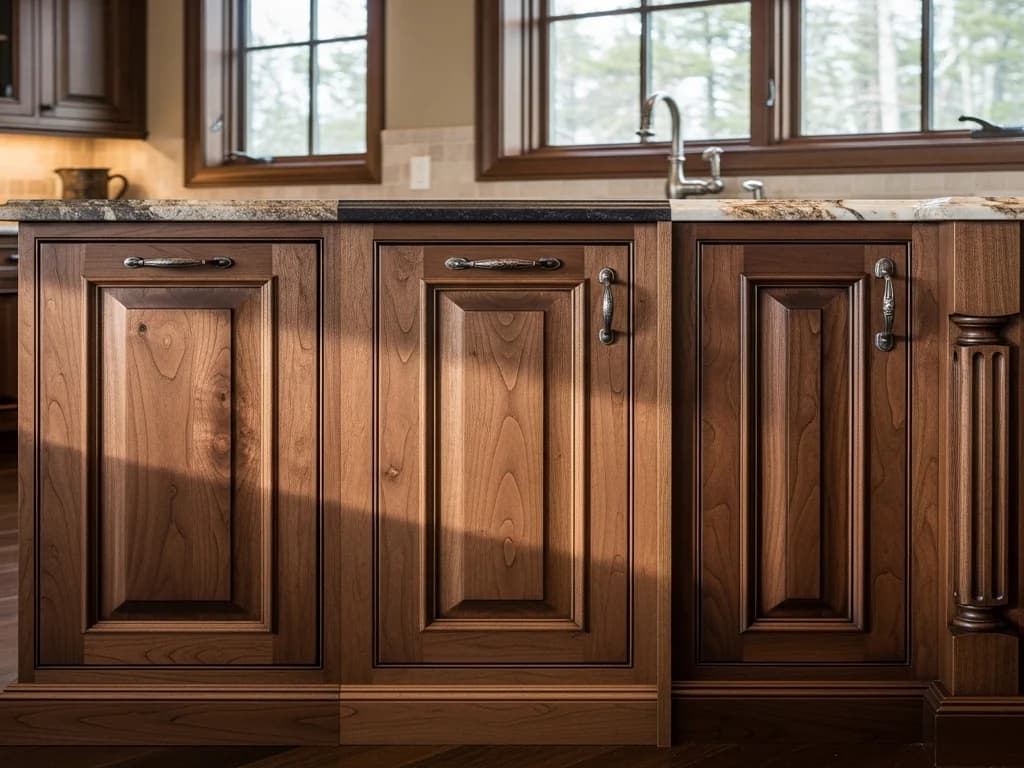
Stock cabinets: fixed sizes off a shelf
Stock cabinets are manufactured in advance in a set of standard widths — typically stepped in three-inch increments — and warehoused until someone buys them. Because nothing is built to order, they are the fastest and least expensive option, and they are what most big-box stores and many builder packages install.
The trade-off is fit. When a run of cabinets doesn’t divide evenly into three-inch boxes, the gap is closed with filler strips. A little filler is normal; a lot of it is a sign the room was forced to accept the boxes instead of the other way around. Construction is usually particleboard or thin plywood cases with a limited menu of door styles, finishes, and interior fittings.
Semi-custom: standard boxes with options
Semi-custom lines start from the same catalog of box sizes as stock but let you modify them — a different door style, a wider selection of finishes, some depth and height changes, and add-on interior hardware. They are built to order, so lead times stretch to several weeks, and the price sits between stock and full custom.
Semi-custom covers a lot of good kitchens. Where it runs into limits is the same place stock does: the underlying grid. If your walls, windows, and appliances don’t line up neatly with catalog dimensions, you are still working around the boxes.
Full custom: built to the room
Fully custom cabinetry has no fixed size grid. Each case is drawn and built to the actual wall, so an island can be exactly as long as the room allows and a run of uppers can reach the ceiling without a soffit or a filler. You choose the wood species, door style, finish, joinery, and interior fittings without being limited to a catalog.
At Alderwood, custom also means the same shop designs, manufactures, and installs the work — so the drawings you approve are the drawings we build from, and the person who planned the kitchen is accountable for how it fits on install day. That single line of accountability is the practical difference between custom and a catalog order routed through separate vendors.
How to choose for your home
The honest answer is that the right tier depends on the house and the goals, not on prestige. A rental turnover or a straightforward laundry room may be perfectly served by stock. A kitchen with awkward angles, a tall ceiling you want to use, or a specific wood and finish you can’t find in a catalog is where custom earns its cost.
- Choose stock when budget and speed lead and the layout is simple.
- Choose semi-custom when you want a specific look but the room fits standard sizes.
- Choose custom when the space is irregular, the ceilings are tall, or the materials and details matter.
Frequently Asked Questions
Is custom cabinetry always more expensive than semi-custom?
Generally yes, because every piece is built to order for your space rather than pulled from standard sizes. The gap narrows on complex rooms, where a semi-custom layout needs so many modifications and filler pieces that custom becomes competitive on both fit and value.
Can you tell custom from stock once it’s installed?
Often, yes — look at the fillers, the reveals around appliances, and whether uppers meet the ceiling cleanly or stop short with a soffit. Custom work tends to have tight, consistent gaps and cabinetry sized to the wall.
Building or remodeling in the Treasure Valley?
Alderwood designs, builds, and installs custom cabinetry in-house across Idaho’s Treasure Valley. Tell us about your project and we’ll start with a design conversation.
Request a Consultation