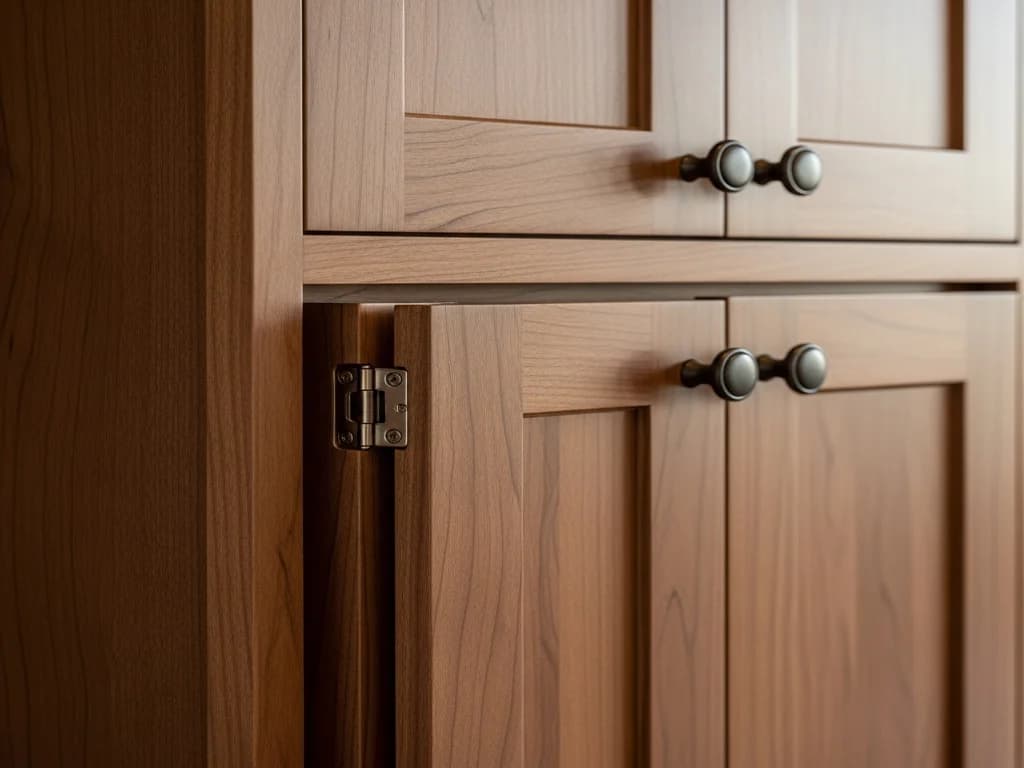
Framed vs. frameless construction
Every cabinet is either framed or frameless. A framed cabinet — the traditional American style — has a face frame, a border of wood around the front of the box that the doors attach to. A frameless cabinet, sometimes called European or full-access, has no face frame; the doors mount directly to the sides of the box.
That single difference drives the three door styles below. Inset and full-overlay are both framed; frameless is its own approach.
Full-overlay: the popular middle ground
On a full-overlay cabinet, the door sits on top of the face frame and covers almost all of it, leaving only a thin reveal between doors. It gives a clean, mostly seamless front while keeping the strength and familiarity of framed construction. It is the most common choice in custom kitchens because it looks current, hides minor wall irregularities, and costs less than inset.
Inset: the tailored, higher-cost classic
On an inset cabinet, the door sits inside the face frame, flush with the front, like a well-made piece of furniture. It is the most traditional and, to many eyes, the most refined look. It is also the most demanding to build: the door has to fit the opening precisely, with consistent gaps all the way around, and wood movement has to be accounted for so the doors don’t bind in humid seasons or gap in dry ones.
That precision is why inset costs the most of the three. In Idaho’s dry climate, inset is very buildable, but it rewards a shop that acclimates its stock and understands how the wood will move.
Frameless: maximum access, modern lines
Frameless cabinets give the most usable interior space and the most contemporary look — drawers can be wider, and there is no center stile blocking a pair of doors. The reveals between doors are typically very thin, close to the seamless look of a modern flat-panel kitchen. Because there is no face frame, precise hardware and square installation matter more; the construction quality carries the whole cabinet.
Which is right for your kitchen?
Style usually decides it. Traditional and transitional homes lean inset or full-overlay; contemporary and minimalist kitchens lean frameless or full-overlay with a slab door. Budget then refines the choice, since inset carries a premium. All three can be built to last — the difference is the look and the cost, not the quality.
Frequently Asked Questions
Is inset worth the extra cost?
If you love the tailored, furniture-like look and it suits your home’s style, many homeowners feel it is. If you mainly want clean lines, full-overlay delivers most of the effect for less.
Does frameless give more storage?
Generally yes. Without a face frame narrowing the opening, drawers and interiors are a bit wider, which adds up across a full kitchen.
Building or remodeling in the Treasure Valley?
Alderwood designs, builds, and installs custom cabinetry in-house across Idaho’s Treasure Valley. Tell us about your project and we’ll start with a design conversation.
Request a Consultation