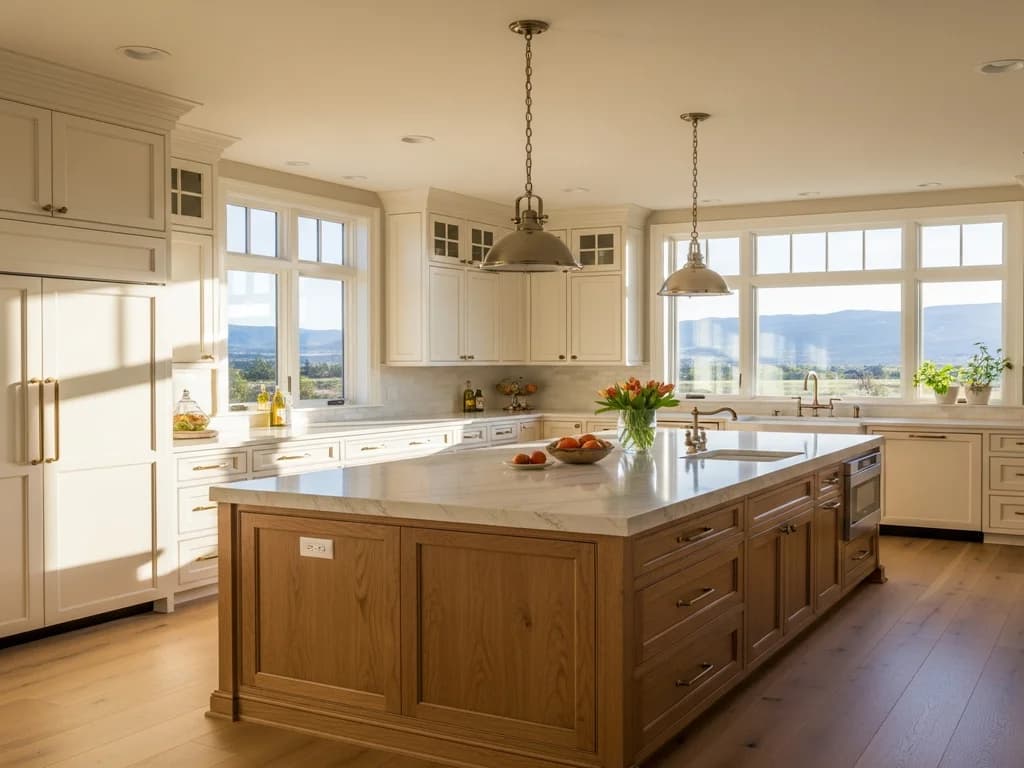
Where semi-custom starts and stops
Semi-custom cabinetry begins from a catalog of standard box sizes and lets you modify them — a wider choice of door styles and finishes, some depth and height changes, and add-on interior hardware. It’s built to order, which is why it costs more than stock, but it’s still working off a fixed grid of sizes. The cost is relatively predictable because it’s built from a priced menu.
Full custom removes the grid entirely. Every case is drawn and built to your actual walls, in any size, wood, and configuration. The cost reflects that each piece is engineered and built for your space rather than pulled from a catalog.
The modification trap
Here’s the counterintuitive part: on a complex kitchen, semi-custom can climb toward custom pricing without you noticing. Every modification — a non-standard width, a reduced depth, a special finish, extra fillers to close the gaps where the grid doesn’t fit the room — is an upcharge. Stack enough of them on an irregular space and the “more affordable” semi-custom quote narrows toward what genuine custom costs, but you still end up with catalog construction and filler strips rather than a true fit.
The real cost drivers
Whichever tier you’re pricing, the same handful of decisions move the number most:
- Construction method — inset costs more than overlay; frameless demands precision.
- Finish — painted and multi-step finishes add labor over a simple clear coat.
- Wood species — prices vary widely from paint-grade maple to walnut.
- Interior fittings — pull-outs, organizers, and specialty storage add up fast.
- Complexity and fit — irregular rooms, tall runs, and furniture details take more time.
When each is the smart spend
Semi-custom is often the right, economical choice for a room that fits standard sizes reasonably well and a look that lives within a catalog’s options. Full custom earns its cost where the room is irregular, the ceilings are tall, the fit has to be exact, or you want a specific wood, finish, or construction the catalog doesn’t offer. The honest test is to price your actual kitchen — on a simple room semi-custom may win clearly, while on a complex one custom often delivers better fit and value for a surprisingly similar number. That’s a conversation we’d rather have with a measured space than a generalization.
Frequently Asked Questions
Can semi-custom cost as much as full custom?
On a complex or irregular kitchen, it can get close. Each modification and filler is an upcharge, so a heavily modified semi-custom quote narrows toward custom pricing — but with catalog construction and fillers rather than a true, built-to-the-wall fit.
What single choice changes the price the most?
Construction and finish together. Inset construction and multi-step or painted finishes are where costs climb fastest, followed by wood species and specialty interior fittings. Choosing these deliberately is the best way to control the budget.
Building or remodeling in the Treasure Valley?
Alderwood designs, builds, and installs custom cabinetry in-house across Idaho’s Treasure Valley. Tell us about your project and we’ll start with a design conversation.
Request a Consultation