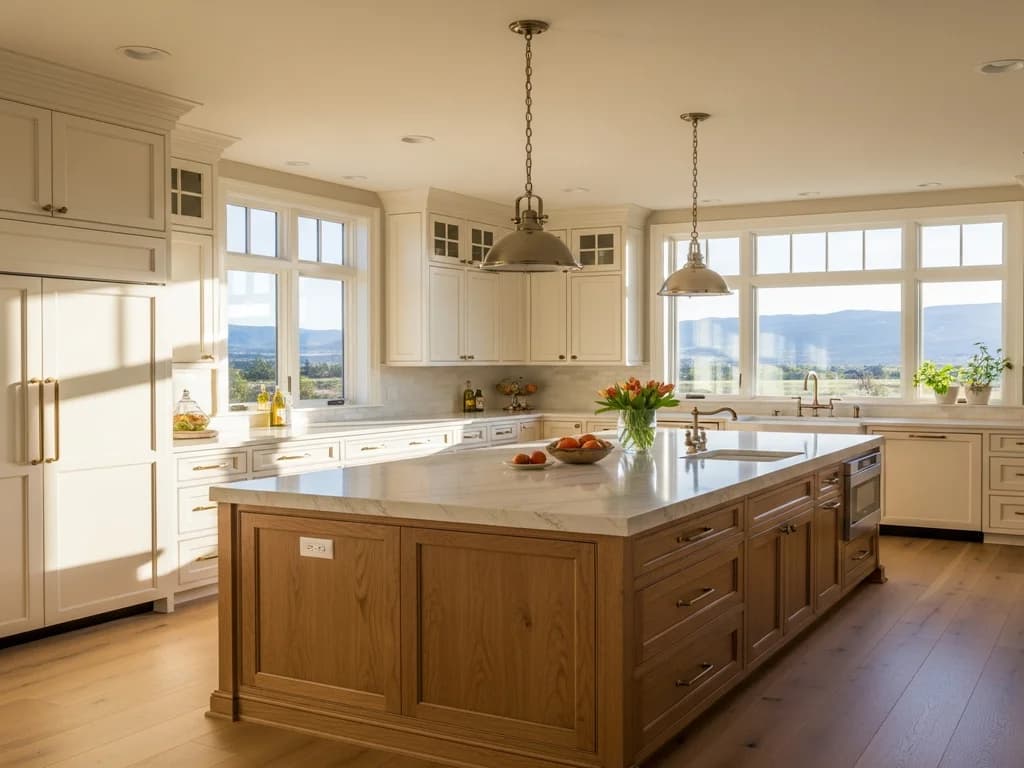
How each is built
A framed cabinet — the traditional American construction — has a face frame: a border of solid wood, typically an inch and a half wide, attached to the front of the box. Doors and drawers mount to that frame, and it adds rigidity and a surface to fit against. A frameless cabinet — often called European or full-access — omits the face frame entirely; the box is built from thicker panels for rigidity, and doors mount directly to the sides of the case.
That one structural difference cascades into almost every practical distinction between the two, from how much fits inside to how the finished kitchen looks.
Storage and access
Frameless cabinets give slightly more usable interior space and easier access, because there’s no face frame narrowing the opening. Drawers can be a bit wider, and there’s no center stile blocking a pair of doors, so you can reach the full width of the interior. Across a whole kitchen, that extra access adds up. Framed cabinets give up a little of that opening to the face frame, though modern “full-overlay” framed cabinetry recovers much of the visual benefit.
Strength, and how each handles the house
Both, built well, are plenty strong. The face frame gives framed cabinets extra front rigidity and a little forgiveness during installation, since the frame can be scribed to an out-of-square wall. Frameless cabinets rely entirely on thick, square boxes and precise installation — there’s no frame to hide behind — so construction quality and a careful install carry the whole cabinet. In skilled hands both are excellent; frameless simply leaves less margin for sloppy work.
The look
Framed cabinetry can be built as inset (doors flush within the frame) or overlay (doors on top of the frame), which makes it the more traditional and flexible choice for classic, transitional, and furniture-style kitchens. Frameless leans contemporary: thin, consistent reveals and, with a slab door, a nearly seamless modern front. Neither look is better; they suit different homes. The mountain-modern and transitional homes common in the Treasure Valley are built beautifully either way.
- Framed — traditional, allows inset or overlay, forgiving to install.
- Frameless — contemporary, maximum access, demands precise construction.
- Both are excellent when built well; the choice is look and access, not quality.
Which to choose
Style usually decides it. If you want inset doors or a traditional, furniture-like feel, framed is the natural path. If you want the cleanest contemporary lines and maximum interior access, frameless leads. Because we build both in our own shop, we can steer the choice by what suits your home and how you want the kitchen to look and work — not by what a single factory happens to produce.
Frequently Asked Questions
Is frameless stronger than framed?
Both are plenty strong when built well. Framed cabinets gain front rigidity from the face frame and are a touch more forgiving to install; frameless relies on thick, square boxes and precise installation. Neither is inherently better — it comes down to construction quality.
Can I get inset doors on a frameless cabinet?
No — inset doors sit within a face frame, so inset is a framed construction. Frameless cabinets use overlay doors with thin reveals. If you want the flush, furniture-like inset look, you want framed construction.
Building or remodeling in the Treasure Valley?
Alderwood designs, builds, and installs custom cabinetry in-house across Idaho’s Treasure Valley. Tell us about your project and we’ll start with a design conversation.
Request a Consultation