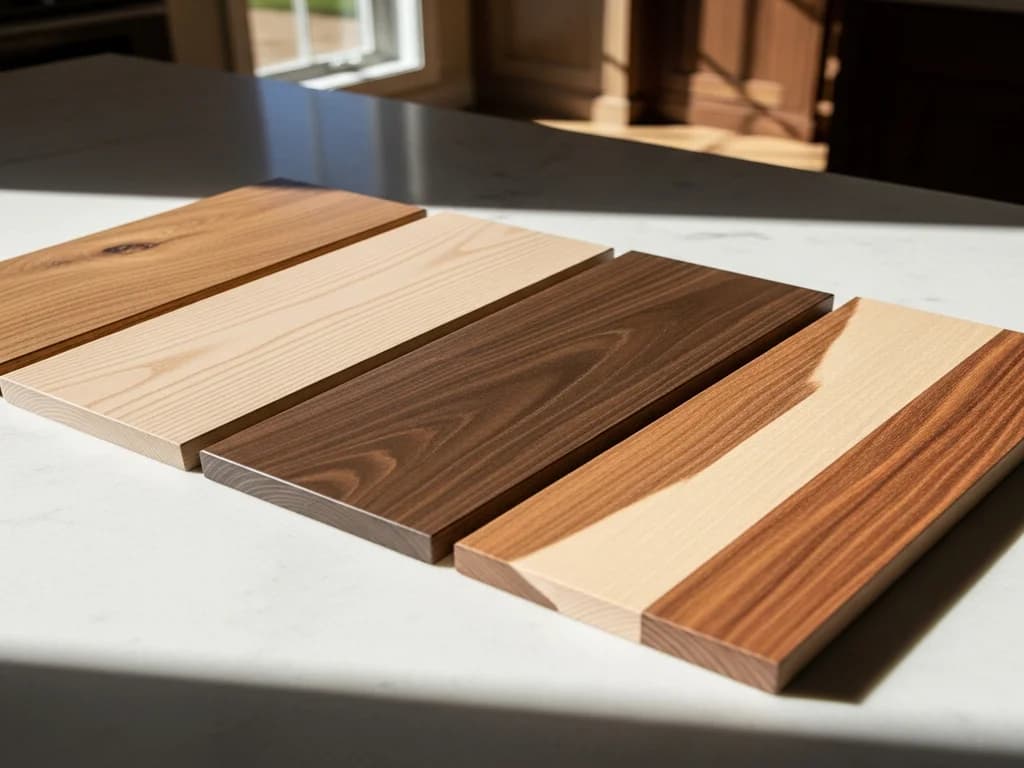
Knotty alder: the Idaho mountain-home standard
Alder is a softer hardwood with a warm, even tone and a grain that takes stain beautifully. In its knotty grade it carries tight knots and character marks that read as rustic and handmade — a natural fit for the foothill and mountain-modern homes common around Eagle, Boise’s foothills, and Star.
Because it is on the softer end of the hardwoods, alder can dent more easily than oak or hickory, which is worth weighing for a busy family kitchen. Many homeowners consider that patina part of the appeal; others choose a clear-grade alder for a cleaner face and fewer knots.
White oak: durable, current, and versatile
White oak has become the default for homeowners who want a contemporary look that still feels warm. It is hard, dimensionally stable, and its open, straight grain suits both a natural clear finish and the light, wire-brushed and rift-cut looks trending in new construction.
Rift and quartersawn cuts of white oak give the tight, linear grain you see in higher-end modern kitchens, while plain-sawn shows more of the cathedral figure. It’s a wood that holds up to daily use and photographs as “current” without being trendy in a way that dates quickly.
Hickory: the toughest of the four
Hickory is the hardest and most dramatic of these species, with strong color variation between pale sapwood and darker heartwood. That contrast is polarizing — people tend to love it or avoid it — but its hardness makes it an excellent choice for high-traffic kitchens and homes with kids and dogs.
Because of its bold grain, hickory reads best in rustic and transitional designs where the wood itself is meant to be the statement rather than a painted or uniform surface.
Maple: smooth, and the go-to for paint
Maple is a hard, close-grained wood with a subtle figure. Stained, it gives a clean, understated look; but its real strength is as a paint substrate. Because the grain is so fine, painted maple yields a smooth, furniture-grade surface without the open pores telegraphing through — which is why most painted inset and Shaker cabinetry is built on maple or a maple-and-MDF combination.
Matching the wood to Idaho’s climate
The Treasure Valley is high-desert dry, with low indoor humidity for much of the year and real seasonal swings. All solid wood moves with those swings, so species stability and construction matter as much as looks. White oak and maple are more forgiving of dry conditions than some softer or more figured woods, and good construction — engineered plywood cases, floating panels, properly acclimated stock — is what keeps any species stable here.
Frequently Asked Questions
Which cabinet wood is most durable for a family kitchen?
Hickory is the hardest of the common cabinet woods, followed by hard maple and white oak. Alder is softer and dents more easily, though many homeowners like the lived-in character that develops.
What wood is best if I want painted cabinets?
Maple, usually paired with MDF center panels. Its fine, closed grain paints to a smooth surface without open pores showing through the finish.
Building or remodeling in the Treasure Valley?
Alderwood designs, builds, and installs custom cabinetry in-house across Idaho’s Treasure Valley. Tell us about your project and we’ll start with a design conversation.
Request a Consultation