Let one element lead
The most reliable principle in pairing cabinetry and countertops is to let one be the star and the other support it. A bold, heavily veined stone wants a quieter cabinet finish so the room doesn’t compete with itself; a dramatic cabinet wood or a saturated painted color is best set against a calmer, near-solid countertop. When both the cabinetry and the counter shout, a kitchen can feel busy and unsettled — deciding early which one leads keeps it composed.
Warm and cool tones
Undertone matters as much as color. Warm woods like walnut, alder, and honey-toned oak pair naturally with countertops that carry cream, beige, or warm-gray tones; cool, crisp painted cabinetry — bright whites and cool grays — sits comfortably with cooler white-and-gray stones and marble looks. Mixing a very warm wood with a very cool gray stone can work as a deliberate contrast, but it has to be intentional and balanced by other elements in the room.
Contrast for definition
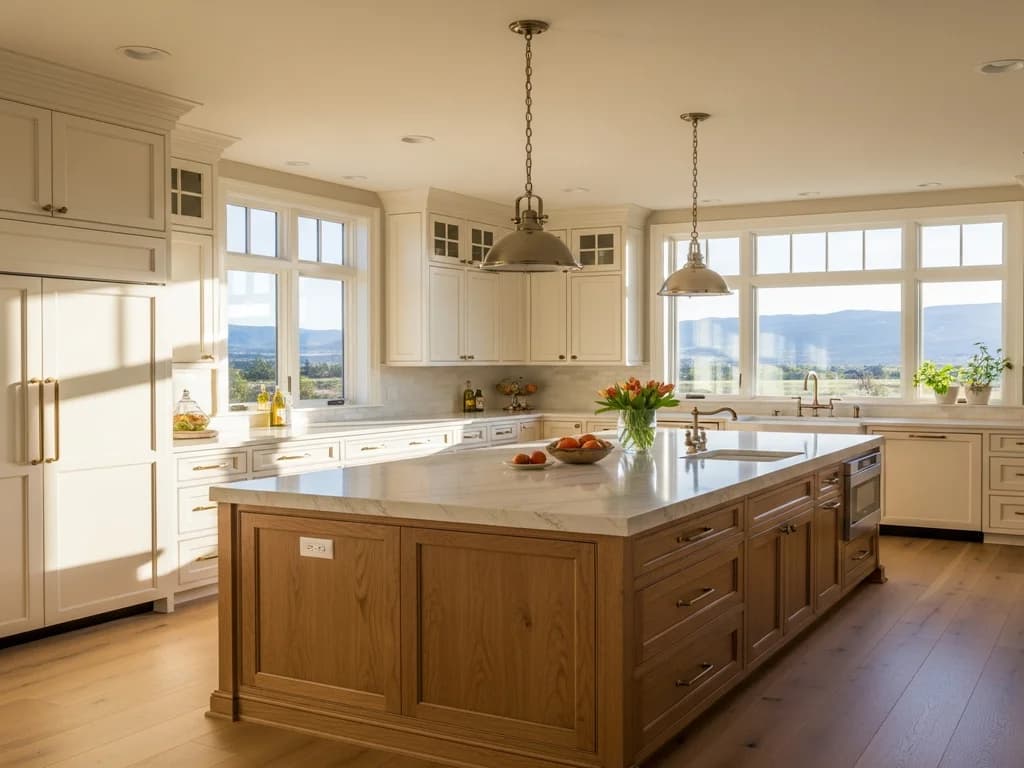
Some contrast between cabinetry and countertop usually reads better than a near-match. Light cabinetry with a darker counter, or dark cabinetry with a lighter surface, gives the eye definition and keeps the kitchen from looking flat. In a two-tone kitchen, the countertop often becomes the neutral thread that ties a painted perimeter and a wood island together, so it’s chosen to relate to both.
- Quiet counter + bold cabinets, or bold counter + quiet cabinets.
- Match undertones — warm with warm, cool with cool — unless contrast is deliberate.
- Some light/dark contrast usually beats a near-match.
- In two-tone kitchens, let the counter tie the palette together.
Don’t forget the edge and the backsplash
The countertop’s edge profile and how it meets the backsplash are part of the pairing too. A simple eased or square edge suits modern and transitional cabinetry; a more shaped edge leans traditional. A full-height stone backsplash reads seamless and contemporary, while a tile backsplash introduces its own color and texture that has to relate to both cabinetry and counter. Selecting all of it together against real samples — which is how we run material selection during design — is what prevents the mismatch that shows up only after installation.
Frequently Asked Questions
Should cabinets and countertops match or contrast?
Usually a bit of contrast reads better than a near-match — light cabinets with a darker counter, or vice versa, gives the eye definition. The key rule is to let one element lead and the other support it rather than having both compete.
How do I know if a countertop’s tone works with my cabinets?
Match undertones. Warm woods pair with cream and warm-gray stones; cool painted cabinetry pairs with cooler whites and grays. Selecting both against real samples together, rather than separately, is the surest way to avoid a mismatch.
Building or remodeling in the Treasure Valley?
Alderwood designs, builds, and installs custom cabinetry in-house across Idaho’s Treasure Valley. Tell us about your project and we’ll start with a design conversation.
Request a Consultation