A quick note on scope
We build cabinetry, not countertops — but the two are chosen together, so it’s worth understanding your options before selecting cabinet wood and finish. The right pairing is what makes a kitchen feel resolved. What follows is a practical overview to help that conversation, not a fabrication or a stone-shop sales pitch.
Engineered quartz: low-maintenance and consistent
Quartz countertops are engineered from ground natural quartz bound with resin, which makes them non-porous, highly stain-resistant, and free of the periodic sealing that natural stone needs. The color and pattern are consistent slab to slab, so what you approve is what you get, and many quartz lines now convincingly imitate marble’s veining without marble’s upkeep.
The trade-offs are that quartz can be damaged by high heat, so trivets matter near the range, and because the pattern is manufactured, it doesn’t have the one-of-a-kind depth of a natural stone. For busy family kitchens, its durability and near-zero maintenance make it the default choice for many Treasure Valley homeowners.
Granite: natural, tough, and characterful
Granite is a hard, heat-resistant natural stone with genuine variation — every slab is unique, and the movement and mineral flecks give it a depth engineered surfaces don’t quite match. It stands up well to daily use and hot pans. Because it’s porous, it needs periodic sealing to resist stains, though a well-sealed granite is very forgiving in practice.
Granite suits homeowners who want the character of real stone and a range of looks from quiet, near-solid slabs to dramatic, veined ones. Pairing a busy granite with a quieter cabinet finish — or a bold cabinet color with a calm stone — keeps the room balanced.
Marble: the classic look, with real trade-offs
Marble is the timeless, luxurious choice — its soft veining and cool depth are unmatched, which is why it anchors so many high-end kitchens. But it’s softer and more porous than granite or quartz, so it etches when it meets acids like lemon or wine and scratches more easily. Owners have to accept a lived-in patina or commit to careful maintenance and sealing.
Many homeowners who love the look choose it for a lower-traffic zone — a baking station or a butler’s pantry — or accept the patina as part of the charm, while using quartz or granite on the hardest-working runs.
Pairing the countertop with your cabinetry
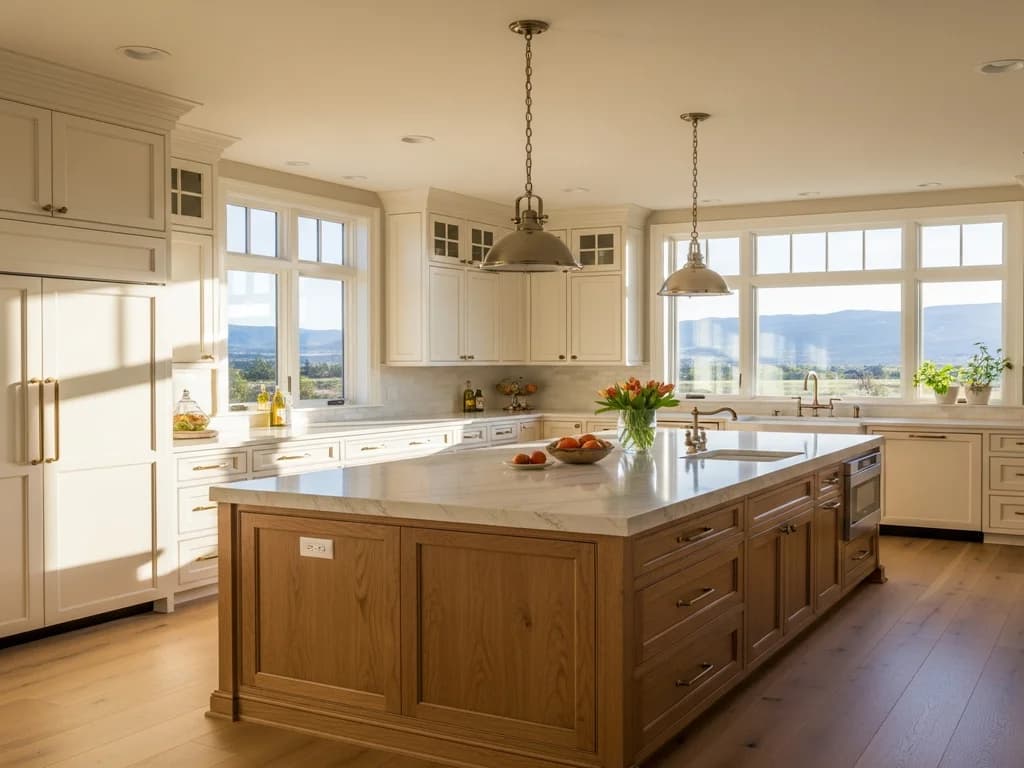
The general rule is to let one element be the star. A quiet countertop lets a bold cabinet wood or color lead; a dramatic, veined slab is best paired with a calmer cabinet finish. Warm woods like walnut and alder pair beautifully with cream and beige-toned stones; crisp painted cabinetry can take a cooler white-and-gray marble look. We help you make these selections against real samples during design, so the cabinetry and countertop are decided as a pair rather than in isolation.
Frequently Asked Questions
Which countertop needs the least maintenance?
Engineered quartz. It’s non-porous, so it never needs sealing and resists stains well. Granite and marble are natural stones that benefit from periodic sealing, and marble in particular needs the most care.
Should I choose cabinets or countertop first?
Choose them together. The best results come from selecting cabinet wood, finish, and countertop as a coordinated pair against real samples, letting one be the star and the other play a supporting role.
Building or remodeling in the Treasure Valley?
Alderwood designs, builds, and installs custom cabinetry in-house across Idaho’s Treasure Valley. Tell us about your project and we’ll start with a design conversation.
Request a Consultation