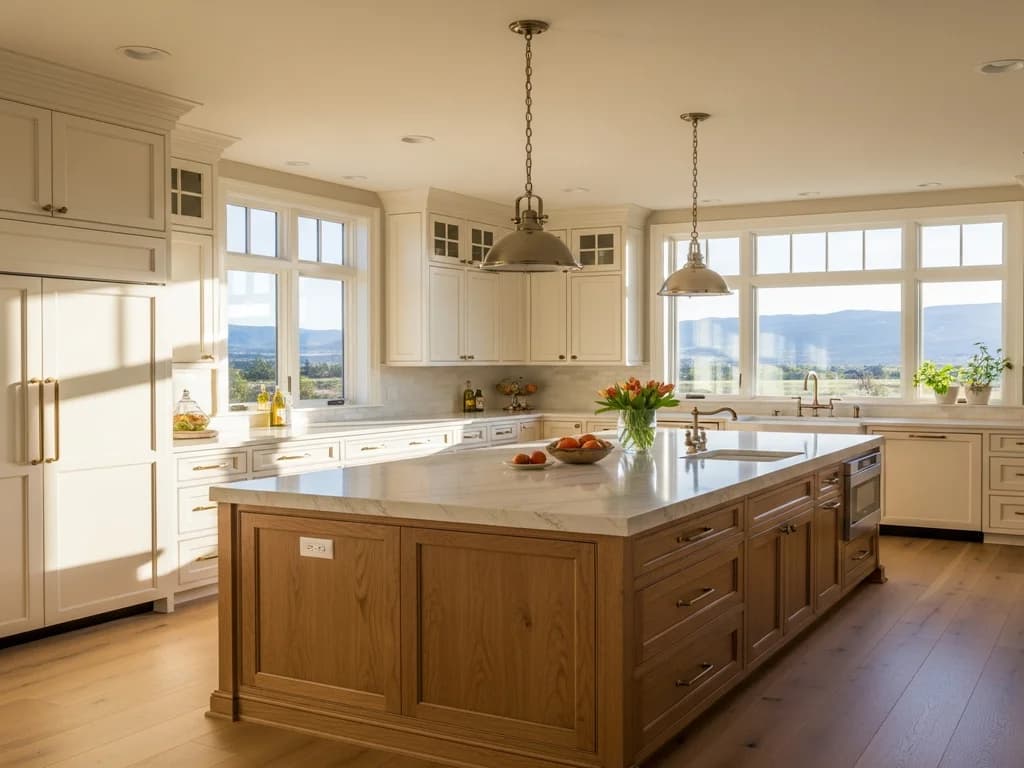
Why the topcoat matters
Whatever color a cabinet is stained or painted, the clear topcoat over it is what actually meets the world — the moisture, the cleaning, the fingerprints, the daily wear. A beautiful finish over a weak topcoat won’t hold up; a durable topcoat is what keeps cabinetry looking right for decades. That’s why the type of finish a shop uses is one of the more important, and least discussed, questions a buyer can ask.
Conversion varnish and catalyzed finishes
Conversion varnish is a catalyzed finish — a coating that includes an acid catalyst, triggering a chemical cure that hardens it well beyond what an air-dried finish achieves. The result is a hard, durable topcoat highly resistant to moisture, household chemicals, heat, and abrasion, which is why it’s a standard for quality kitchen and bath cabinetry. Other catalyzed finishes, like post-catalyzed lacquer and two-component polyurethanes, work on a similar principle: a chemical cure creates a tougher film than one that simply dries.
- Conversion varnish — chemically cured, very hard and chemical-resistant.
- Catalyzed lacquers — a durable step up from traditional lacquer.
- Two-component polyurethane — extremely tough, used for high-wear work.
- Traditional nitrocellulose lacquer — beautiful but softer and less resistant.
Traditional lacquer’s place
Traditional nitrocellulose lacquer sprays and levels beautifully and has a lovely depth, and it’s easy to repair because new lacquer melts into the old. Its limitation is durability: it’s softer and less resistant to moisture, heat, and chemicals than a catalyzed finish, so on hard-working kitchen cabinetry it can show wear sooner. It still has a place for certain furniture and lower-wear pieces, but for a kitchen that faces daily cooking and cleaning, a catalyzed finish generally serves better.
Why finishing happens in the shop
Catalyzed finishes have to be mixed, applied, and cured under controlled conditions — the right temperature, humidity, and dust-free environment, with proper cure time between coats. That’s exactly why quality cabinetry is finished in the shop rather than on site, and why a painted or multi-step finish can’t be rushed. In Idaho’s dry, swinging climate, a properly applied catalyzed finish on the right substrate is a big part of what keeps cabinetry stable and good-looking for the long haul. We finish in-house for precisely this control.
Frequently Asked Questions
What’s the most durable finish for kitchen cabinets?
A catalyzed finish such as conversion varnish. Its chemical cure produces a hard topcoat highly resistant to moisture, heat, chemicals, and abrasion, which is why it’s a standard for quality kitchen and bath cabinetry that faces daily wear.
Is lacquer a bad choice for cabinets?
Not bad, just softer. Traditional nitrocellulose lacquer sprays beautifully and is easy to repair, but it resists moisture, heat, and chemicals less than a catalyzed finish, so for a hard-working kitchen a conversion varnish or catalyzed finish generally holds up better.
Building or remodeling in the Treasure Valley?
Alderwood designs, builds, and installs custom cabinetry in-house across Idaho’s Treasure Valley. Tell us about your project and we’ll start with a design conversation.
Request a Consultation