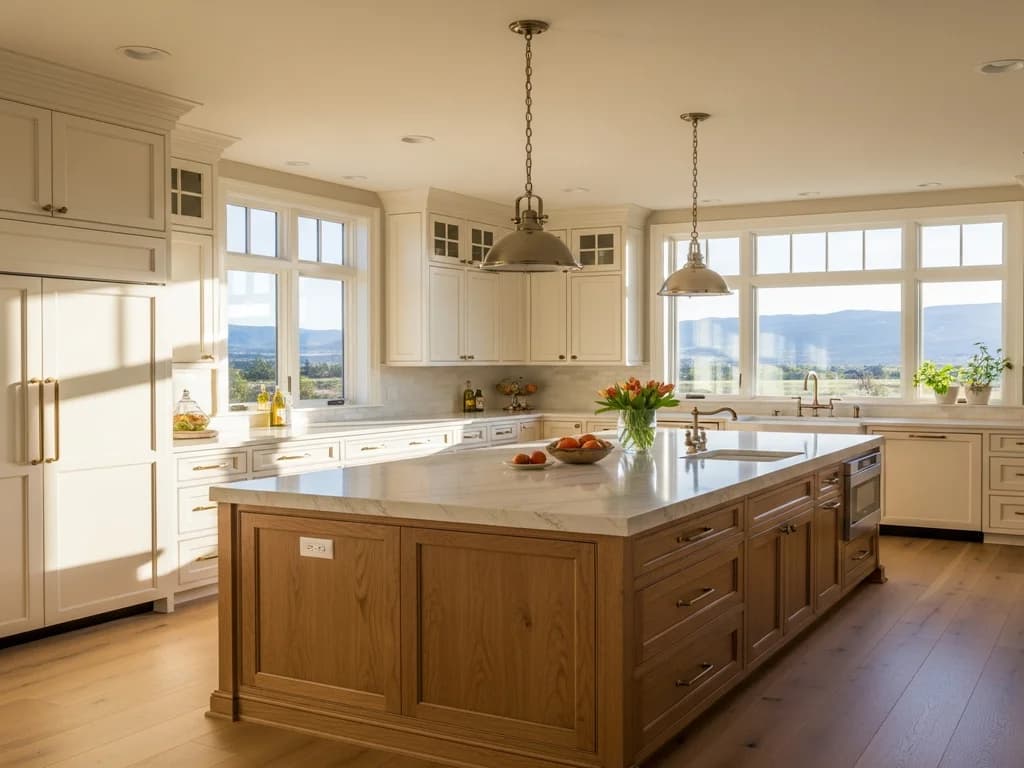
Three materials, three jobs
Cabinet construction isn’t a contest between materials — it’s a matter of using each where it performs best. Solid wood, plywood, and MDF have different strengths, and a well-built cabinet often combines all three: solid wood where strength and grain matter, plywood for stable cases, and MDF for flat, paint-ready panels. Understanding what each does well explains why the “all solid wood” pitch is more of a marketing line than a mark of quality.
Solid wood: strength and grain where it shows
Solid wood is the material for the parts that need real strength and the parts where you want to see and feel the grain — door frames and stiles, face frames, drawer fronts, and the visible wood of a stained kitchen. Its weakness is movement: wide solid-wood panels expand and contract with humidity and can cup or split if used where they can’t move. That’s why good cabinetmaking uses solid wood for frames and lets a floating panel — sometimes a more stable material — fill the center.
Plywood: the stable case material
For the cabinet boxes themselves, quality custom cabinetry uses plywood. Cross-laminated plies make it dimensionally stable — it resists the swelling and shrinking that would trouble a wide solid panel — while holding screws and joints well and standing up to moisture better than particleboard. A plywood case is the mark of a well-built cabinet, and it’s a genuine step up from the particleboard boxes common in stock and budget lines.
- Solid wood — door frames, face frames, drawer boxes, visible grain.
- Plywood — stable, strong cabinet cases that hold hardware well.
- MDF — flat, seam-free center panels for painted doors.
- A quality cabinet uses all three, each where it performs best.
MDF: the right choice under paint
MDF — medium-density fiberboard — is dense, uniform, and has no grain, which makes it the ideal substrate for painted center panels. It’s dimensionally stable, so it won’t move and telegraph a seam through the paint the way a solid panel can, and it paints to a dead-flat, furniture-smooth surface. Using MDF for painted door panels isn’t a cost-cutting shortcut; it’s the correct material for the job, which is why even high-end painted cabinetry uses it exactly there while keeping solid wood for the frames.
What good construction looks like
Put together, a well-built painted cabinet typically has plywood cases, solid-wood door frames and drawer boxes, and MDF center panels — each material doing what it does best. A stained cabinet leans more on solid wood and plywood, since the grain is on show. The point isn’t any single material but the intelligent combination, and that’s what separates cabinetry built to last from a box built to a price. We build to that standard because it’s what actually holds up in Idaho’s dry, swinging climate.
Frequently Asked Questions
Is solid wood always better than MDF or plywood?
No. Quality cabinetry uses all three where each performs best — plywood for stable cases, solid wood for frames and drawer boxes, and MDF for flat, seam-free painted panels. Using MDF under paint isn’t cost-cutting; it’s the correct material for that job.
What should the cabinet boxes be made of?
Plywood. Cross-laminated plywood is dimensionally stable, holds screws and joints well, and resists moisture better than the particleboard used in many stock and budget lines, which is why it’s the mark of a well-built custom cabinet.
Why use MDF for painted cabinet doors?
Because it has no grain and doesn’t move, MDF paints to a dead-flat, furniture-smooth surface and won’t telegraph a seam through the paint the way a solid-wood panel can. Even high-end painted cabinetry uses MDF center panels for exactly this reason.
Building or remodeling in the Treasure Valley?
Alderwood designs, builds, and installs custom cabinetry in-house across Idaho’s Treasure Valley. Tell us about your project and we’ll start with a design conversation.
Request a Consultation