The paint substrate — smooth, hard, and understated
Hard Maple Cabinets
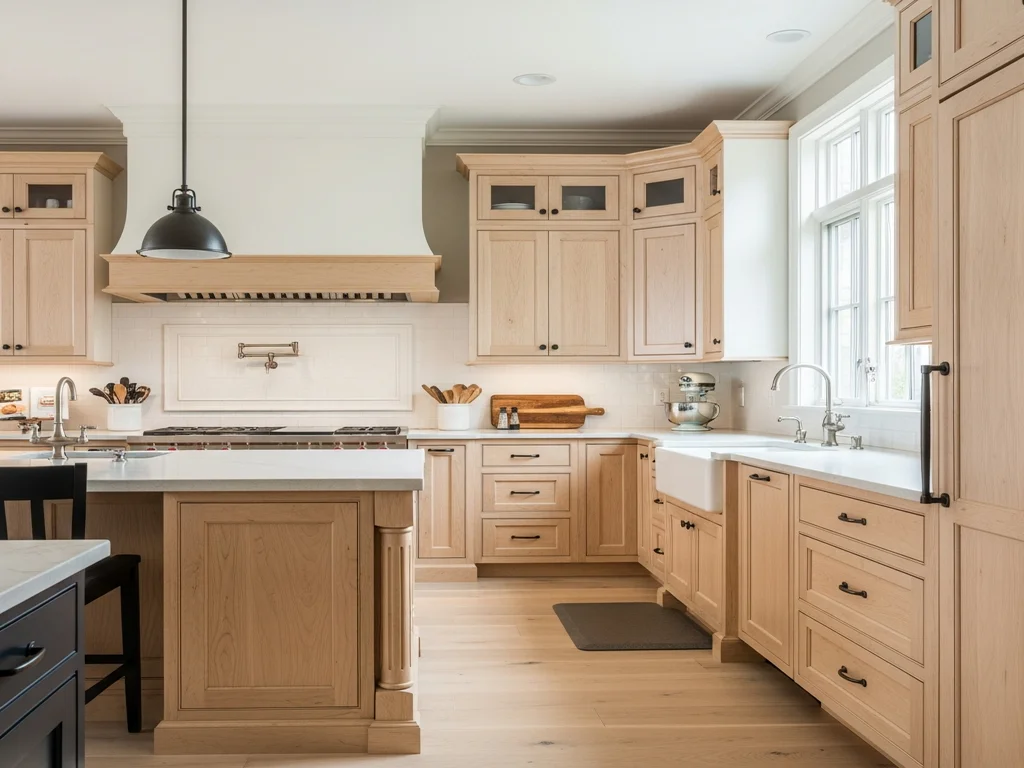
Hard maple is the workhorse behind most painted cabinetry, including nearly every crisp white and inset kitchen we build. Its fine, closed grain finishes dead-flat and its hardness stands up to daily life, which is why it is the standard when the wood is meant to disappear under color.
- Grain
- Very fine, closed, subtle grain
- Color
- Creamy near-white, occasional amber and mineral streak
- Hardness (Janka)
- 1,450 lbf
- Cost tier
- Value (illustrative)
Character and grain
Hard maple (sugar maple) is a dense, fine-grained hardwood with a subtle, close figure and a pale, creamy near-white color. Its grain is so tight and uniform that it reads almost smooth from a short distance — the opposite of oak or hickory. That very quality is its purpose: with no open pores to telegraph through a finish, maple gives the flattest, most furniture-grade painted surface of any wood we build. Occasional amber streaks, small bird’s-eye flecks, and mineral marks appear and are sorted out for painted work.
How it takes paint and stain
Paint is where maple earns its keep. Its closed grain finishes to a smooth, poreless surface that shows a clean color the way a lacquered piece of furniture does — the reason classic white, off-white, and colored kitchens are almost always built on maple, usually paired with MDF center panels that stay flat through seasonal change. Maple can be stained, giving a clean, understated, tight-grained look, but it is famously blotchy with dark stains because its dense grain absorbs unevenly; we condition it first and generally steer clients toward lighter stains or clear finishes when they want the wood to show, and toward oak or walnut when they want dramatic dark tone.
Hardness and Idaho durability
At roughly 1,450 on the Janka scale, hard maple is one of the hardest domestic cabinet woods — the same wood used for bowling alleys and butcher blocks. That toughness makes painted maple cabinetry genuinely resilient in a busy family kitchen. In the dry Treasure Valley climate, painted wood joints can develop very fine hairline seam lines over the years as the wood moves, most visible on bright white; building the center panels in MDF and floating them properly is what keeps that to a minimum, and it is far less noticeable than on a lesser substrate.
Cost and where it fits a budget
Maple is one of the better values in solid hardwood — abundant, workable, and priced below oak, cherry, and walnut. Because it is the standard paint-grade wood, choosing painted maple is often the most cost-effective path to a crisp, high-end-looking kitchen. Stain-grade maple selected for consistent color costs a bit more.
Door styles and kitchen styles it suits
Maple is the natural home of the painted Shaker and painted inset door — the two most-requested looks we build — as well as raised-panel and beaded traditional doors. It underpins classic, transitional, modern-farmhouse, and colored-cabinet kitchens across every kind of Treasure Valley home, from north-end bungalows to new builds in Meridian and Kuna. When you picture a smooth white kitchen, you are almost certainly picturing painted maple.
Still weighing one wood against another? Our cabinet wood species guide compares knotty alder, white oak, hickory, maple, and walnut side by side to help you choose the right one for your home.
Hard Maple at a Glance
- Very fine, closed grain finishes dead-flat under paint
- Creamy near-white natural color
- One of the hardest domestic cabinet woods (Janka ~1,450)
- The standard substrate for painted and inset cabinetry
- A strong value among solid hardwoods
Hard Maple Cabinets — Common Questions
Why is maple the best wood for painted cabinets?
Maple’s grain is very fine and closed, with no open pores to telegraph through the finish, so paint lays down to a smooth, furniture-grade surface. It is also hard and durable. We build painted maple doors with MDF center panels so the flat surface stays flat through seasonal change.
Can maple cabinets be stained a dark color?
They can, but maple is prone to blotching with dark stains because its dense grain absorbs unevenly. We pre-condition the wood to even it out, but for a rich, dark stained look we usually recommend oak or walnut instead. Maple is at its best painted or in lighter, clean stain tones.
Will painted maple cabinets crack or show lines over time?
Any painted wood can develop very fine hairline seam lines over years as it moves with the seasons, most visible on bright white. Building the center panels in MDF and floating them properly minimizes it, and maple’s hardness and stability make it one of the best-behaved substrates for paint in a dry climate.
Explore Our Other Cabinet Woods
Knotty Alder Cabinets
Warm, knotty, and made for foothill and mountain-modern homes — the wood our shop is named after.
Learn MoreWhite Oak Cabinets
Rift and quarter-sawn white oak — the tight, linear grain behind today’s warm-modern kitchens.
Learn MoreBlack Walnut Cabinets
Rich chocolate tone and an elegant, stable grain — the wood we reach for on islands and feature pieces.
Learn MoreHickory Cabinets
The hardest and most dramatic cabinet wood — bold grain, high contrast, built to take a beating.
Learn MoreAmerican Cherry Cabinets
A smooth, satiny grain that deepens to a warm reddish glow — the classic furniture hardwood.
Learn MoreServing the Treasure Valley
Keep Planning Your Hard Maple Kitchen
We design, build, and install hard maple cabinetry for homeowners and builders across Treasure Valley, Idaho. Explore the styles and services behind a custom project.
Ready to Build in Hard Maple?
Every Alderwood project begins with a design conversation. Tell us about your space and the wood you love, and we'll take it from there.