The modern default — clean grain, warm and current
White Oak Cabinets
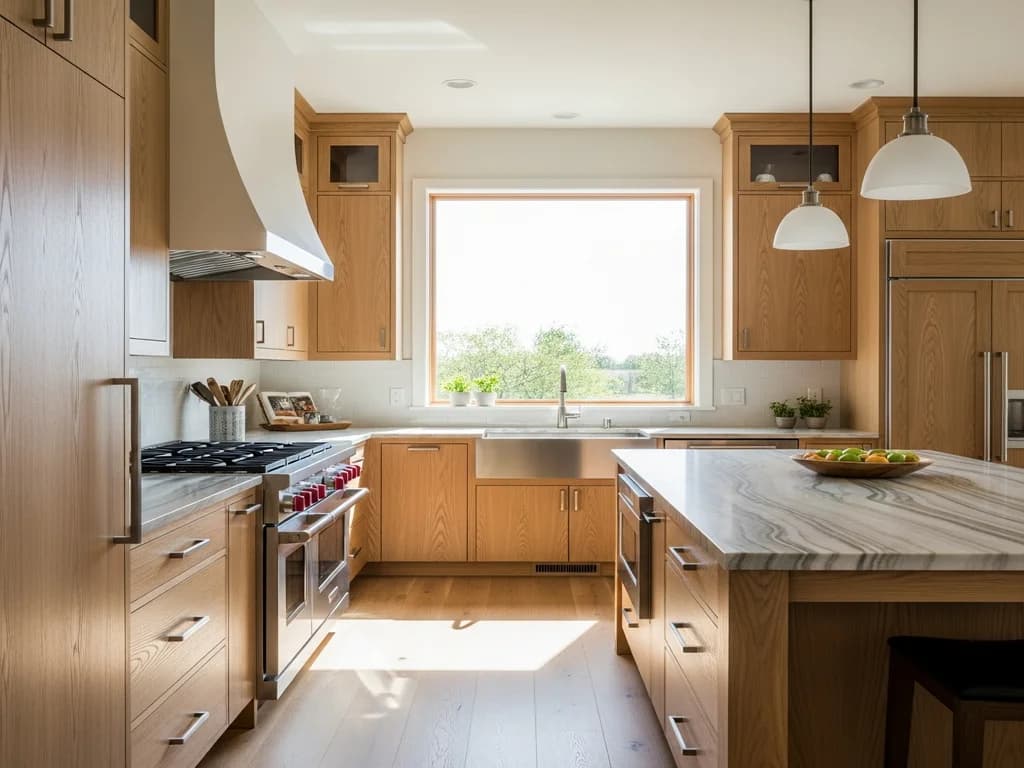
White oak has become the default for a modern kitchen that still feels warm, and it is one of the most-requested woods in new Treasure Valley construction. How it is cut — rift, quarter-sawn, or plain-sawn — changes the look entirely, from tight straight lines to dramatic cathedral figure.
- Grain
- Open grain; rift/quarter-sawn reads tight and linear
- Color
- Pale golden-brown with a cool, neutral cast
- Hardness (Janka)
- 1,350 lbf
- Cost tier
- Mid-range (illustrative)
Character and grain
White oak is a hard, dense, open-grained hardwood with a naturally cooler, more neutral tone than red oak — which is why designers moved to it for contemporary work. The cut is everything. Rift-sawn white oak shows a tight, straight, almost pinstripe grain with no cathedrals, the cleanest and most modern look. Quarter-sawn adds the flecked "ray fleck" figure prized in craftsman and Mission work. Plain-sawn is the most economical and shows the familiar cathedral arches. For slab and modern Shaker doors we specify rift or rift-and-quartered so the grain runs in clean vertical lines.
Color and how it takes finish
Left natural under a clear coat, white oak is a pale golden-brown that reads light and airy — the look behind so many current kitchens. Its open pores make it a natural for wire-brushed and cerused finishes, where the grain is opened and highlighted for texture. It also takes stain well across a wide range, from bleached and white-washed tones through warm honey to deep fumed browns, though very light tones can show a slight green or pink undertone that a good finisher neutralizes. Because the grain is a feature, white oak is almost always stained or clear-finished rather than painted.
Hardness and Idaho durability
At roughly 1,350 on the Janka scale, white oak is genuinely hard and holds up to heavy daily use — comparable to hard maple and far tougher than alder or cherry. It is also closed-cell and historically rot-resistant (the reason it was used for ships and barrels), which makes it dimensionally reliable. In the dry Treasure Valley climate, quarter-sawn and rift cuts are the most stable of all, moving very little across the seasons, so they are an excellent choice for wide doors and long runs where you want joints to stay tight.
Cost and where it fits a budget
White oak sits in the mid-to-upper range. Plain-sawn is the most affordable; rift and quarter-sawn cost more because the log yields far less of them, and rift-and-quartered doors carry a premium for the tight vertical grain. It is more than alder or maple but well below walnut — a sensible splurge when the wood grain itself is central to the design.
Door styles and kitchen styles it suits
White oak is the signature wood of flat slab and clean modern Shaker doors, especially in frameless construction with slim or integrated hardware. It anchors modern, contemporary, Scandinavian, and warm-transitional kitchens, and works beautifully in two-tone schemes — a natural oak island against painted perimeter cabinets is one of the most-requested directions we build. It suits the clean-lined new builds across Meridian, Eagle, and the Boise foothills.
Still weighing one wood against another? Our cabinet wood species guide compares knotty alder, white oak, hickory, maple, and walnut side by side to help you choose the right one for your home.
White Oak at a Glance
- Rift & quarter-sawn cuts give a tight, modern linear grain
- Pale, neutral tone that reads light and current
- Excellent for wire-brushed and natural clear finishes
- Hard and stable (Janka ~1,350) — quarter-sawn is the most stable cut we build
- The default for modern, contemporary & two-tone kitchens
White Oak Cabinets — Common Questions
What is the difference between rift, quarter-sawn and plain-sawn white oak?
They are different ways of cutting the same log. Rift-sawn shows a tight, straight, pinstripe grain with no cathedrals — the cleanest, most modern look and the most expensive. Quarter-sawn adds a flecked ray figure. Plain-sawn is the most economical and shows the familiar cathedral arches. For modern kitchens we usually specify rift or rift-and-quartered.
Is white oak better than red oak for cabinets?
For a modern look, most people prefer white oak: it has a cooler, more neutral tone and a smoother grain, where red oak carries a pink cast and stronger cathedral pattern. White oak is also denser and more water-resistant. Red oak is more affordable and can look excellent in traditional settings.
Does white oak work in a dry climate like the Treasure Valley?
Very well. White oak is hard, closed-cell, and dimensionally stable, and quarter-sawn and rift cuts are the most stable of all — they move very little through Idaho’s seasonal humidity swings. Paired with plywood cases and floating panels, it stays tight for years.
Should white oak cabinets be stained or left natural?
Most white oak kitchens are finished natural or lightly stained so the grain shows — that pale, warm-modern look is the reason people choose it. It also takes wire-brushed, cerused, and fumed finishes for added texture. It is rarely painted, since paint would hide the grain that makes it worth the cost.
Explore Our Other Cabinet Woods
Knotty Alder Cabinets
Warm, knotty, and made for foothill and mountain-modern homes — the wood our shop is named after.
Learn MoreBlack Walnut Cabinets
Rich chocolate tone and an elegant, stable grain — the wood we reach for on islands and feature pieces.
Learn MoreHard Maple Cabinets
Fine-grained and hard — the go-to substrate for smooth painted and inset cabinetry.
Learn MoreHickory Cabinets
The hardest and most dramatic cabinet wood — bold grain, high contrast, built to take a beating.
Learn MoreAmerican Cherry Cabinets
A smooth, satiny grain that deepens to a warm reddish glow — the classic furniture hardwood.
Learn MoreServing the Treasure Valley
Keep Planning Your White Oak Kitchen
We design, build, and install white oak cabinetry for homeowners and builders across Treasure Valley, Idaho. Explore the styles and services behind a custom project.
Ready to Build in White Oak?
Every Alderwood project begins with a design conversation. Tell us about your space and the wood you love, and we'll take it from there.