The premium hardwood for feature pieces and islands
Black Walnut Cabinets
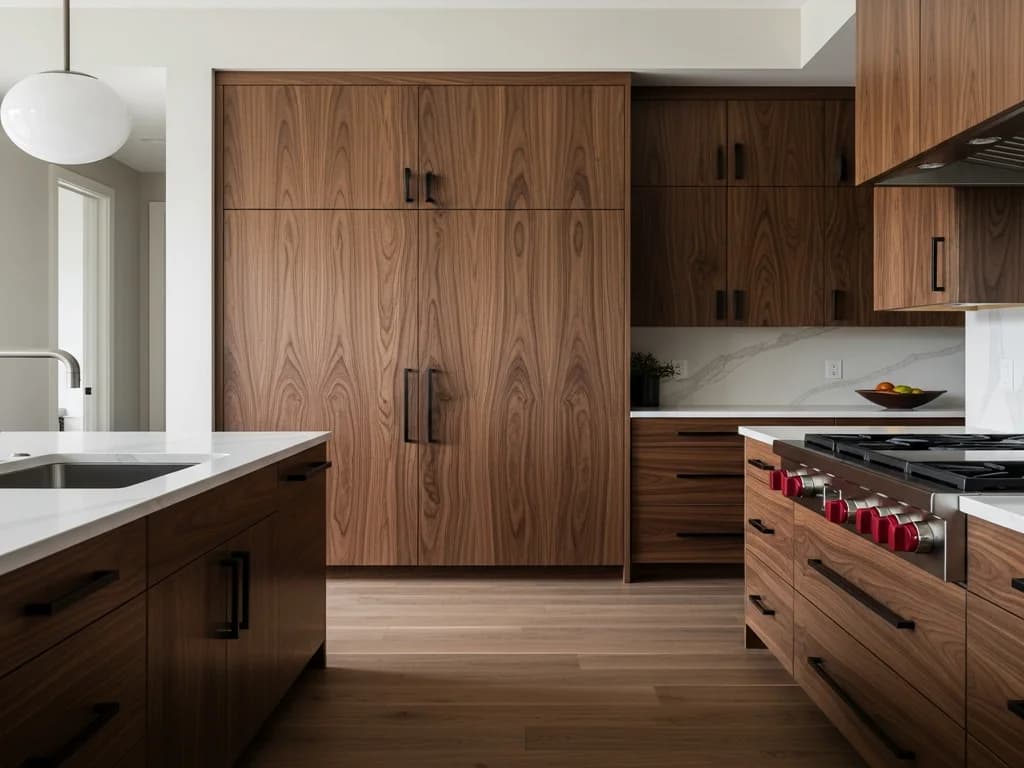
Black walnut is the premium hardwood in our shop — a deep chocolate-brown wood with a straight, flowing grain that needs no stain to look luxurious. Because the material carries a real cost, it is often the star of a kitchen rather than the whole cast: an island, a hood surround, a wall of furniture-style cabinetry.
- Grain
- Straight to gently wavy, occasional curl and figure
- Color
- Deep chocolate-brown, lightens gracefully with age
- Hardness (Janka)
- 1,010 lbf
- Cost tier
- Premium (illustrative)
Character and grain
American black walnut is the only common cabinet wood that is naturally dark, with a rich chocolate-brown heartwood, a straight-to-gently-wavy grain, and frequent flashes of curl, crotch, and burl figure that make each board distinct. The sapwood is pale cream, and how a shop handles that contrast — selecting all-heartwood boards or letting the lighter sap show — is part of the design conversation. Its natural depth means walnut looks expensive with nothing more than a clear finish; the wood does the work.
Color and how it takes finish
Almost all walnut cabinetry is finished with a clear or natural oil coat that lets the native color and figure show — staining walnut darker usually muddies what makes it special. One quirk sets it apart from every other wood here: walnut lightens with age and sunlight, mellowing from deep espresso toward a warmer, honeyed brown over years, where most woods darken. A quality UV-inhibiting topcoat slows that shift. Walnut is never painted; covering it would defeat the entire reason to choose it.
Hardness and Idaho durability
At roughly 1,010 on the Janka scale, walnut is a true hardwood — harder than cherry, softer than oak or hickory. It is prized for being both strong and dimensionally stable, holding its shape well through seasonal change, which is why it has been the gunstock and fine-furniture wood of choice for centuries. In the dry Treasure Valley air it behaves reliably. It is hard enough for everyday kitchen use, though on a heavily worked island we finish it with a durable catalyzed topcoat and remind clients the color will warm over time.
Cost and where it fits a budget
Walnut is the top of our material range. Domestic supply is limited, the trees yield less usable lumber than oak or maple, and figured boards command a premium — so a full walnut kitchen is a genuine investment. That is exactly why it is most often used as an accent: a walnut island against painted perimeter cabinets, a walnut hood, or a furniture-style hutch delivers the luxury of the wood while keeping the overall budget in check.
Door styles and kitchen styles it suits
Walnut is stunning on flat slab and clean modern Shaker doors, where the uninterrupted grain becomes the focal point, and equally at home on furniture-style raised-panel pieces. It defines contemporary-luxe, mid-century-modern, and warm-transitional kitchens, and pairs beautifully with brass or matte-black hardware, quartz or marble counters, and lighter perimeter cabinetry that lets it stand out. It suits the higher-end custom homes of Eagle, the Boise foothills, and the north-end.
Still weighing one wood against another? Our cabinet wood species guide compares knotty alder, white oak, hickory, maple, and walnut side by side to help you choose the right one for your home.
Black Walnut at a Glance
- Naturally dark chocolate tone — no stain required
- Elegant straight grain with frequent curl and burl figure
- Dimensionally stable and strong (Janka ~1,010)
- Lightens and warms with age, unlike most woods
- The luxury choice for islands and furniture-style feature pieces
Black Walnut Cabinets — Common Questions
Why are walnut cabinets more expensive?
Walnut is a limited domestic hardwood: the trees are slower-growing and yield less usable lumber than oak or maple, and figured boards command a premium. Its naturally rich color and fine-furniture reputation add to demand. That cost is why walnut is often used as an accent — an island or hood — rather than throughout a whole kitchen.
Do walnut cabinets fade or change color over time?
They lighten, which is the opposite of most woods. Walnut mellows from deep espresso toward a warmer, honeyed brown with age and sun exposure. A quality UV-inhibiting topcoat slows the shift considerably. Many homeowners love the way it softens; it is a natural characteristic, not a defect.
Should walnut be stained or finished natural?
Finished natural, almost always. Walnut’s native color and grain are the reason to choose it, so a clear or natural-oil finish lets the wood speak. Staining it darker tends to muddy the figure. We do apply a durable, UV-inhibiting clear topcoat for protection and to slow the natural lightening.
Explore Our Other Cabinet Woods
Knotty Alder Cabinets
Warm, knotty, and made for foothill and mountain-modern homes — the wood our shop is named after.
Learn MoreWhite Oak Cabinets
Rift and quarter-sawn white oak — the tight, linear grain behind today’s warm-modern kitchens.
Learn MoreHard Maple Cabinets
Fine-grained and hard — the go-to substrate for smooth painted and inset cabinetry.
Learn MoreHickory Cabinets
The hardest and most dramatic cabinet wood — bold grain, high contrast, built to take a beating.
Learn MoreAmerican Cherry Cabinets
A smooth, satiny grain that deepens to a warm reddish glow — the classic furniture hardwood.
Learn MoreServing the Treasure Valley
Keep Planning Your Black Walnut Kitchen
We design, build, and install black walnut cabinetry for homeowners and builders across Treasure Valley, Idaho. Explore the styles and services behind a custom project.
Ready to Build in Black Walnut?
Every Alderwood project begins with a design conversation. Tell us about your space and the wood you love, and we'll take it from there.